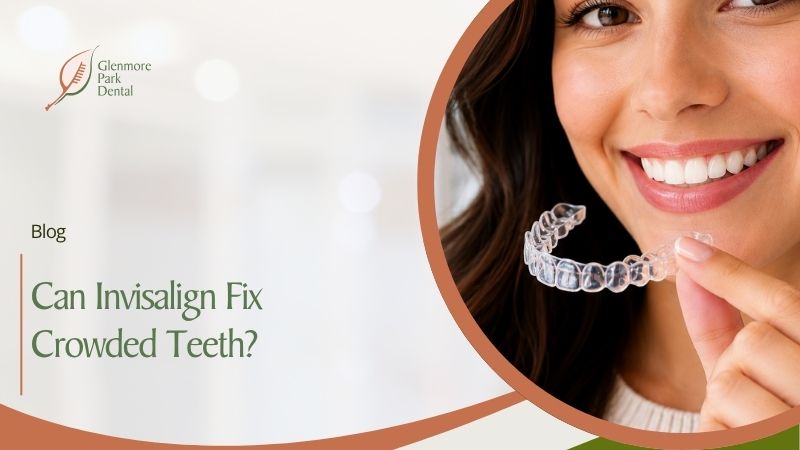
If your teeth overlap, twist, or appear crowded, you may wonder whether Invisalign can actually correct the problem. The good news is that crowded teeth are one of the most common concerns that Invisalign is designed to treat. Using a series of custom clear aligners, Invisalign gradually moves teeth into healthier, more balanced positions without the brackets and wires associated with traditional braces. At Glenmore Park Dental, we help patients throughout Marda Loop, Lakeview, Glenbrook, Glenmorgan, and Acadia determine whether Invisalign is the right solution for their smile goals. In this blog, we'll explain how Invisalign treats crowded teeth, what causes crowding, and what you can expect during treatment. Beyond improving appearance, correcting crowded teeth can also make brushing and flossing easier, helping reduce the risk of cavities, gum disease, and uneven tooth wear over time. If you're considering Invisalign for discreet orthodontic treatment, understanding your options is the first step toward a healthier, straighter smile.
WHY CROWDED TEETH SHOULD NOT BE IGNORED
Many people think crowded teeth are purely a cosmetic concern. While appearance is often the reason patients seek treatment, crowding can create several oral health challenges that extend far beyond aesthetics.
Crowded teeth occur when there is not enough space in the jaw to properly accommodate all of the teeth. As a result, teeth may overlap, rotate, or become displaced from their ideal positions.
Common causes of crowded teeth include:
One of the biggest concerns with crowding is oral hygiene. When teeth overlap, it becomes more difficult to effectively brush and floss between them. Plaque and food particles can accumulate in areas that are difficult to reach, increasing the risk of:
Crowded teeth can also create bite imbalances. When teeth do not fit together properly, certain teeth may absorb more force during chewing than others. Over time, this can contribute to uneven wear, chipping, or jaw discomfort.
Addressing crowding early often improves both oral health and smile appearance while reducing the risk of future complications.
HOW INVISALIGN CORRECTS CROWDED TEETH
Invisalign uses a series of custom-made clear aligners that gradually guide teeth into better alignment. Each aligner is designed to make small, controlled movements, creating space and improving tooth positioning throughout treatment.
The process begins with a digital assessment. Using advanced imaging technology, your dentist can create a detailed treatment plan that maps how your teeth will move over time.
In many crowding cases, Invisalign works by:
One advantage of Invisalign is the ability to visualize potential results before treatment begins. Digital treatment planning allows patients to see projected tooth movement and anticipated outcomes.
Many patients choose Invisalign because it offers several lifestyle benefits:
However, successful Invisalign treatment depends heavily on compliance. Aligners typically need to be worn for 20 to 22 hours per day to achieve optimal results. Removing them too frequently can delay progress and extend treatment times.
The severity of the crowding also plays a role. Mild to moderate crowding is often highly treatable with Invisalign. More complex orthodontic issues may require additional treatment planning or alternative approaches.
WHAT TO EXPECT FROM YOUR INVISALIGN CONSULTATION
The first step toward determining whether Invisalign can fix your crowded teeth is a professional consultation.
At Glenmore Park Dental, we evaluate several factors before recommending treatment, including:
During your consultation, digital scans may be taken to create a detailed model of your teeth. These scans eliminate the need for traditional impressions while providing highly accurate treatment planning information.
If Invisalign is appropriate, your treatment plan will outline:
Many patients are surprised to learn that crowding can continue to worsen with age. Teeth naturally shift over time, particularly if orthodontic treatment was never completed or retainers were not worn consistently. Seeking treatment sooner may help prevent more significant crowding from developing later.
Once treatment is complete, retainers play a critical role in maintaining results. Without proper retention, teeth can gradually begin shifting back toward their original positions.
Crowded teeth can affect more than just your smile's appearance. They can increase the risk of cavities, gum disease, uneven tooth wear, and oral hygiene challenges. Fortunately, Invisalign provides an effective and discreet treatment option for many patients experiencing mild to moderate crowding.
At Glenmore Park Dental, we help patients throughout Marda Loop, Lakeview, Glenbrook, Glenmorgan, Acadia, and surrounding Calgary communities determine whether Invisalign is the right solution for their orthodontic needs. If you're ready to explore a straighter, healthier smile, contact our team today to schedule an Invisalign consultation.
Invisalign can successfully treat many cases of mild to moderate crowding and some more complex situations. The severity of the crowding, bite alignment, and overall oral health will determine whether Invisalign is the best treatment option. A professional consultation is the best way to assess your specific case.
Treatment time varies depending on the degree of crowding and patient compliance. Many Invisalign cases are completed within 12 to 18 months, although some patients may see results sooner. Wearing aligners for the recommended 20 to 22 hours per day is essential for staying on schedule.
Without retainers, teeth can gradually shift over time. This natural movement can occur whether treatment was completed using Invisalign or traditional braces. Wearing retainers as directed after treatment helps maintain your results and protect your investment in your smile.
Have a question about your dental health or ready to book an appointment? Our friendly team is here to help! Fill out the form below, and we’ll get back to you as soon as possible.

Glenmore Park Dental—Trusted Family Dentist in Calgary.
Since 2001, we’ve been Calgary’s trusted choice for general dentistry, implants, Invisalign, and advanced treatments like biofilm removal and Zoom whitening. With a warm, welcoming atmosphere and a commitment to patient comfort, we make every visit stress-free. Conveniently located for easy access from Glenmore and Crowchild, we proudly serve families across Marda Loop, Acadia, Lakeview, Glenbrook, and beyond.
Book your appointment today and smile with confidence!